
viagladiola
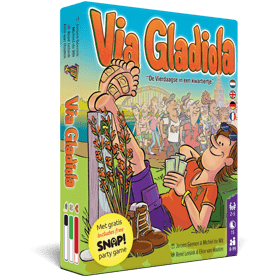 Via Gladiola is a fast-paced ladder-climbing card game inspired by the legendary Nijmegen Four Days Marches. Over four rounds—one for each day—players try to finish the march with as few blisters as possible.
Each day starts at kilometer 0 and ends at 50. On your turn, you either "walk" by playing a higher card to the pile, or “stand still” and draw a penalty card. You can safely advance up to 5 km. Go 6–10 km ahead and you must draw 1 card; 11–15 km costs you 2. Anything more isn’t allowed—you’re pushing too hard.
On day 4 only, the 'gladiola' cards can make your life a little easier, as you Can play these to stand still without having to draw a penalty card.
Finish your hand efficiently and avoid stacking up blister icons. After four days, the player with the fewest blisters wins.
Število igralcev: 2 - 5
Igralni čas: 11 mn
Kompleksnost: 1 / 5
Igraj viagladiola in 1326 ostalih iger online.
Brez dodatnih prenosov, neposredno iz vašega brskalnika.
S prijatelji in tisoči igralcev iz celega sveta.
Zastonj.


Igraj viagladiola in 1326 ostalih iger online.
Brez dodatnih prenosov, neposredno iz vašega brskalnika.
S prijatelji in tisoči igralcev iz celega sveta.
Zastonj.
Povzetek pravil
Via Gladiola OVERVIEW In Via Gladiola, players take part in a four-day walking challenge inspired by the Nijmegen Marches. Each turn, you decide whether to keep walking, take a short rest, or celebrate your progress with a Gladiola. Play your cards in sequence to advance — but pace yourself! Walking too far too fast causes injuries and discomfort. After four days, the player with the least total discomfort wins the march.
COMPONENTS 67 cards:
  • 49 Kilometer cards (values 1–49, each unique, showing 0–5 discomfort symbols (X) and 3 pace intervals)
  • 4 Start cards (value 0)
  • 6 End cards (value 50, 0–2 discomfort symbols)
  • 8 Gladiola cards (1–5 discomfort symbols)
SETUP
  1. Place one Start card (0) face up in the center of the table. This begins the walk pile.
  2. Shuffle all remaining cards — including the End cards (50) and Gladiolas — into a single draw pile.
  3. Deal 7 cards to each player.
  4. The player who most recently went for a walk begins.
PLAYING THE GAME Players take turns clockwise. On your turn, choose one of the following actions:
Walk, Stand Still or Play a Gladiola.
ACTION 1 - WALK Play one card from your hand with a higher value than the top card of the walk pile and place it on top to advance. How far you walk determines how tired you become. The top card on the walk pile shows 4 colored pace indicators that show the lowest number for 4 intervals. The intervals are the same for all cards:
 Interval Meaning
  +1 to +5 Safe pace – draw no cards
  +6 to +10 Pushed too far – draw 1 card
  +11 to +15 Overexerted – draw 2 cards
  > +15 Too far – not allowed
End cards (with value 50) may also be played (if the step size allows). Playing an End card immediately ends the current day.
ACTION 2 - STAND STILL Play nothing and draw 1 card from the draw pile. Sometimes resting is better than risking fatigue.
ACTION 3 - PLAY A GLADIOLA (Day 4 only) During day 4, you may choose this action instead of Walking or Standing Still. Play a Gladiola card and place it beside the walk pile as a symbol of your triumph. Gladiolas do not affect card order or cause any draws.
End of a Day When an End card (50) is played, the current day ends immediately. Leave the 50 in place, then add a new Start card (0) beside the pile to begin the next day.
Example of Play Three players — Alex, Bobbie, and Charlie — are walking on Day 1. The top card on the walk pile is 12.
 • Alex plays 16, a safe pace (+4).
     Alex draws nothing.
  • Bobbie plays 23, a pushed pace (+7).
     They draw 1 card.
  • Charlie can’t play higher than 23, so they Stand
     Still and draw 1 card.
  • Alex now plays 34, overexerting (+11) and drawing 2 cards.
  • Later, Bobbie plays a 50, ending Day 1. They place a new Start card (0) to begin Day 2.
Empty Draw Pile In the unlikely event that the draw pile runs out of cards, recycle the oldest completed day first. Take all cards from the earliest completed day that has not yet been recycled (starting with Day 1), excluding that day’s Start card (0). Shuffle those cards to form a new draw pile. If the pile runs out again later, repeat the process with the next oldest completed day (Day 2, then Day 3). When needed, continue in this way until the end of Day 4.
End of the Game When the fourth day ends it is time for final scoring to determine the winner: • Each player adds up the number of discomfort symbols on the cards remaining in their hand. • The player with the lowest total discomfort wins. • If tied, the player with fewer cards wins. • If still tied, players share the victory.